What Can't Go in a Dumpster in Wisconsin?
Wisconsin's landfill bans are stricter than most states', and they are law rather than guidance. A refused load costs a day and a wasted trip.
In this guide
- Why Wisconsin's list is longer than most
- The banned list, and when each item was added
- Yard waste
- Corrugated cardboard
- Appliances, electronics and tyres
- Concrete, and the Rock County rule
- Hazardous material and special wastes
- What is perfectly fine
- Where to take the rest
Every load that leaves a property crosses a scale and gets looked at. In Wisconsin the list of things that will get it rejected is longer than in most states, and it exists in statute rather than in a company policy. Ten minutes of sorting beforehand avoids the whole problem.
Why Wisconsin's list is longer than most
Wisconsin took an unusually early and unusually firm position on this. The state's recycling framework was established by 1989 Wisconsin Act 335, now sitting in Chapter 287 of the Wisconsin Statutes, and section 287.07 established outright bans on landfilling or incinerating a range of materials.
The Department of Natural Resources administers it, and local government units — "responsible units" in the statute's language — run the programmes and can add their own ordinances on top. Importantly, the obligations apply to businesses and institutions as well as households, so a contractor or a commercial property is squarely within scope.
Wisconsin also applies surcharges to landfill disposal, totalling somewhere around thirteen dollars a ton, which fund the state's environmental management account and its recycling grant programmes. So the state has both a legal and a financial structure pushing material out of the landfill stream.
The banned list, and when each item was added
The bans arrived in stages, which is worth knowing because people's mental model of what is allowed often dates from whenever they last thought about it.
- 1990: lead-acid batteries, waste oil and major appliances
- 1993: yard waste
- 1995: newspaper, corrugated cardboard, magazines, office paper, steel and bi-metal containers, aluminium, glass containers, and plastic containers coded #1 and #2
Tyres are banned as well, foam polystyrene packaging and plastics #3 through #7 are covered by the ban, and electronics fall under Wisconsin's separate E-Cycle programme rather than general waste.
For a household or renovation project, the ones that actually bite are yard waste, appliances, tyres and cardboard.
Yard waste
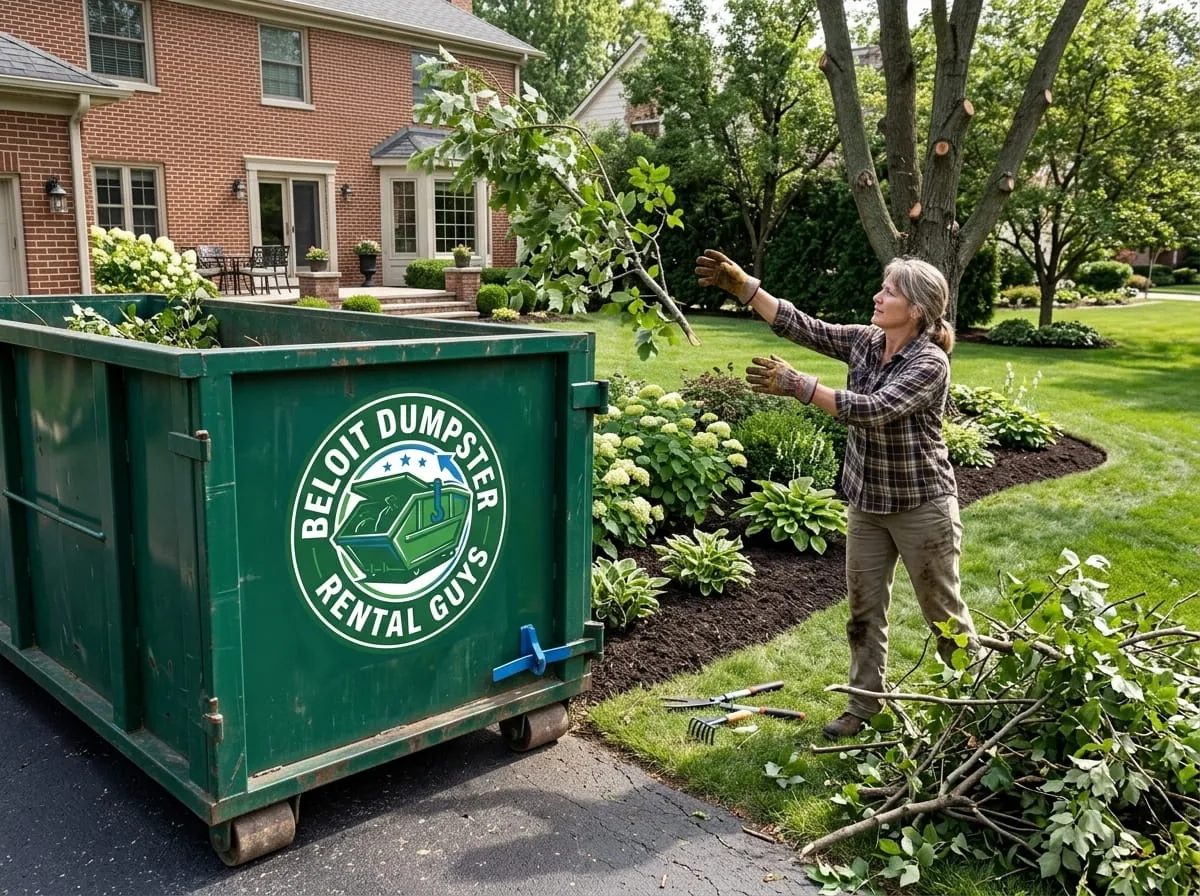
Grass clippings, leaves, garden debris and brush under six inches in diameter have been banned since 1993. They go to an approved compost facility instead, or in some cases to a licensed wood-burning facility.
Locally, Janesville runs a compost site next to the sanitary landfill for city residents, and Town of Beloit residents generally use Complete Compost on East LT Townline Road, where fees apply. Note that the Janesville compost site and clean fill facility do not keep regular winter hours — both close from the beginning of December until the end of March.
The practical point for a container rental: if you are clearing a property and there is brush and garden debris alongside the household material, separate it before it goes in. A load with yard waste mixed through it can be refused.
Corrugated cardboard
This is the one that surprises contractors and commercial customers most, because the volume is so large and the habit of throwing it in the container is so ingrained.
Corrugated cardboard has been banned from landfill disposal in Wisconsin since 1995. On a kitchen fit-out, a retail refresh or a new build's appliance and cabinet delivery phase, cartons are a serious proportion of the total waste. Burying them in a mixed container is not an option here.
Flatten it and set it up as its own stream. On a project of any size that is straightforward to arrange, and given what mixed disposal costs it frequently works out cheaper anyway. On a small residential job, a run to a drop-off is usually enough — the Janesville landfill takes mixed recyclables at a free public drop-off during opening hours.
Appliances, electronics and tyres
Major appliances have been banned since 1990. Anything containing refrigerant — fridges, freezers, dehumidifiers, air conditioners — needs the refrigerant professionally recovered before the shell can be disposed of. Given how many damp basements around here have a dead dehumidifier in them, this comes up constantly on clearances.
Electronics run through E-Cycle Wisconsin rather than general waste. Televisions, monitors, computers and printers all need a collection route rather than a container.
Tyres are banned and handled under their own arrangement, usually with a per-item charge. The Rock County landfill accepts them at its transfer operation, but they do not ride along in a general load.
Lead-acid batteries — car, marine, motorcycle — are banned and readily recycled. Most auto parts retailers take them back, and the Janesville landfill accepts them for recycling.
Concrete, and the Rock County rule
This one is local rather than statewide, and it is important.
The Rock County and City of Janesville Sanitary Landfill on Black Bridge Road bans concrete outright, including reinforced concrete. It goes instead to the separate Clean Fill Facility just west of the landfill.
Two consequences. First, clean masonry always needs its own dedicated container — never mixed into general debris. Second, that Clean Fill Facility closes from the beginning of December until the end of March, so a concrete job in the winter months routes differently and costs differently. Plan it rather than assume it.
Be clear about what does not count as clean fill: gypsum board, plaster, painted or treated timber, anything with sealers, and metal all belong in the general container and go to the sanitary landfill instead.
Hazardous material and special wastes
No liquids of any kind — paint, stains, solvents, thinners, adhesives, pool chemicals, cleaning products. Liquids create leachate, make load weights unpredictable and can react with other material.
Latex paint dried out completely is generally acceptable as solid waste. Leave the lid off in a ventilated space or use a hardener until it is solid throughout. Oil-based paint and solvents cannot be dried out and need a household hazardous waste route.
Fuel, motor oil, transmission and brake fluid and antifreeze all stay out. Propane cylinders are a serious exclusion, including small camping canisters — a sealed pressure vessel in compaction equipment is exactly the hazard it sounds like. Lithium-ion batteries from tools, laptops and e-bikes carry a real fire risk and are a growing problem at waste facilities.
Asbestos cannot go in a roll-off under any circumstances. It requires testing, licensed abatement and documented disposal. At the Rock County landfill, special wastes including asbestos, barrels, contaminated soil and industrial process waste all require approval before they can be deposited at all. Given how much housing around Beloit, Rockton and Janesville predates the 1980s, this is worth checking rather than assuming.
What is perfectly fine
The exclusions read long, but the overwhelming majority of what a renovation or clearance produces is entirely acceptable:
- Timber, framing, plywood, decking and pallets
- Drywall, plaster, lath and non-asbestos insulation
- Roofing shingles, felt, flashing and old decking
- Flooring of all kinds, carpet and underlay
- Cabinets, countertops, doors, windows and fixtures
- Furniture, mattresses and general household contents
- Concrete, brick, block and stone — in a dedicated clean-fill container
- Metal and wiring, though scrap value often makes separating it worthwhile
- Appliances without refrigerant, once you have confirmed that is what they are
Where to take the rest
Yard waste: a compost facility. Janesville's compost site, or Complete Compost for Town of Beloit residents. Closed December through March.
Cardboard and mixed recyclables: free public drop-off at the Janesville landfill during opening hours, or a dedicated container on a larger job.
Car batteries: auto parts retailers, or the Janesville landfill's recycling area.
Waste oil: the landfill accepts small quantities for recycling. It must not be mixed with any other substance or it will be refused.
Electronics: E-Cycle Wisconsin collection points.
Refrigerant appliances: an HVAC or appliance contractor for recovery, after which the shell can be disposed of.
Asbestos: a licensed abatement contractor, with prior approval arranged for disposal.
If you are unsure about something, ring and ask before you load it. That call takes a minute. A refused load takes a day.
Book a container in Beloit
One flat rate covering delivery, seven days, pickup and disposal.
(608) 631-5568Questions readers ask about this
Can I put yard waste in a dumpster in Wisconsin?
No. Wisconsin has banned yard waste from landfill disposal since 1993. Grass, leaves, garden debris and brush go to an approved compost facility instead. Locally that means the Janesville compost site or Complete Compost, both of which close December through March.
Why can't cardboard go in the container?
Corrugated cardboard has been banned from landfill disposal in Wisconsin since 1995. On a fit-out or new build the carton volume is large enough that it needs its own stream. It is state law rather than a preference, so a mixed load can be refused.
Can concrete go in a regular dumpster in Rock County?
No. The Rock County and Janesville sanitary landfill bans concrete outright, including reinforced. It routes to the separate Clean Fill Facility, which closes from the beginning of December until the end of March.
What about asbestos in an older house?
It cannot go in a roll-off under any circumstances and needs licensed abatement. At the Rock County landfill, asbestos is a special waste requiring prior approval. Given how much local housing predates the 1980s, have suspect material tested before disturbing it.